Foodchain

Foodchain
(picture from Foodchain website)

Sunday, May 1, 2016

My Last Visit

Foodchain was probably one of the most memorable areas of service I have gone to work at, and I am sad to say my time there has come to an end. In my video I recognize some of the more upbeat moments of my last time working with the organization.


While working, I was asked many questions from the visiting public. Probably the one question I was most happy to answer though was exactly how an aquaponic system worked and to explain the similarities of the fifty gallon system and the 800 gallon system (both pictured below).


I loved working at Foodchain. And I will definitely never forget the motivation it gave me to give back to my community

Friday, April 29, 2016

Reflection On Serving At Foodchain


Final Post: The Semester's Work Summed Up


In my last post on this blog, I use a video reflection to talk about some of my favorite parts of serving at the FoodChain as well as some of the most challenging things I faced. One thing that I left out of one of my favorite things I did while volunteering at the FoodChain, was on my very last day volunteering, Carter, Asa and I actually constructed a table out of scrap wood the FoodChain had so they could use it in their greeting area. If I am being honest Carter and Asa definitely knew a lot more about how to make a table then I did and did a phenomenal job putting it together while still giving me an opportunity to help when I could and teach me lessons a long the way. It was a very cool experience and I learned a lot. I left that day feeling more proud of my work than ever. We were actually able to see the product of our hard work help out their facility. It was great. As I have said before, I thoroughly enjoyed my time volunteering at the FoodChain and the people I got to work with. I am very thankful for the opportunity to serve the community in an awesome way. It also allowed for a lot of personal growth in my own life. Overall, it was a wonderful experience.

Saturday, April 23, 2016

My Favorite Experience


Recently, during my service with Foodchain, I had the most fun there so far. In my video, I discuss this experience and what exactly made it so great for me. It was nice to finally feel like I was helping Foodchain on the front lines instead of working in the background


As mentioned in the video, here is the picture of all the fish waste that gets collected at the bottom of the tanks. This waste is put into a larger storage tank until it is sold to farms as great fertilizer.

          
Pictures taken by me
Also, here is the table we were able to build. I had a ton of fun building it and I am sure it is something I will never forget.

Picture taken by me

Friday, April 22, 2016

Building Tables, Building Dreams

I have now been to Foodchain a combined four times and it only gets to be more fun every time I go. While I signed up for a volunteer spot during open hours to show visitors around the building, this time they had something different for me. The first thing I was asked to do was help Carter scoop fish poop out of the bottoms of all the planting tanks. This, as you may have guessed, was not the fun part of the day. However, fish poop does not really smell that bad and the work went fairly quickly anyway, with both of us working together it took only about a half hour to clean three tanks. The fun part of our day started when we finished cleaning the tanks and Anne, the volunteer coordinator for Foodchain, told us their borrowed table needed to go back to West Sixth Brewery and she needed us to build her a new one from scratch. Up until this point all we had really done at Foodchain was menial labor such as breaking apart pallets and sweeping so we were happy for the opportunity to do some skilled labor, even if the limit of our tools was a cross cut saw and a power drill. However, this was no trouble for us and we got to work measuring and sawing the boards for the table top right away. Carter and I both had some experience working with power tools so this project was not the liability nightmare it sounds like.
Fairly quickly we had what looked basically like a table top, though lacking some unimportant features such as legs. Then after screwing the whole thing together, and then taking it all apart again as we neglected to screw the boards in on the correct side of the table top, we were ready to begin sanding the top of the table.
The sanding portion did not take long as the wood we used already had a somewhat smooth top and we were soon ready to replace to old borrowed table with our new and improved, homemade table. We did need to get creative in order to put legs under it but luckily there were milk crates and cinder blocks that worked better than we could have hoped.
Though our table may not be the prettiest one every built, we all hope that it will serve Foodchain for years to come and hopefully one day it will be upgraded to have legs as well. Perhaps that can be the next project we tackle at Foodchain.

Final Reflection on My Time Spent at FoodChain


With the spring semester rounding up and the school year coming to a close, I wanted to do one final blog post regarding my service learning organization the FoodChain. This video speaks on my reflection of volunteering at the FoodChain over the course of this past semester. I am very grateful that I was able to serve at such a place. Their vision and passion for the community is contagious. I plan to go back and help in ways I can this summer and over the course of my next four years here at the University of Kentucky. Overall, I am extremely thankful for the people at FoodChain and the time I got to spend there. It has been a wonderful experience that I will not forget!

Friday, April 8, 2016

Video Reflection

So far volunteering at Foodchain has been a mostly lackluster, with the volunteer opportunities being mostly fairly dull, such as sweeping the floors or sitting and waiting to show visitors around the facility during open hours. This is not a huge complaint as I understand they need work done that is not extraordinarily exciting and generally I am happy to oblige. However, this Thursday's volunteer opportunity certainly took the cake for dull and hard work when my group mates and I spent roughly 3 hours breaking apart wooden pallets by hand with crowbars and claw hammers.
My office for the day.
However, though it might have been fairly dull and hard work, I was happy to help Foodchain in any way I could, even if it was not particularly exciting. I definitely am still looking forward to my next visit to Foodchain, whatever the work they need done may be.

Service So Far


Up to this point, volunteering at Foodchain has really begun to hit a high note. In my video I talk about what has kick-started this enthusiasm compared to how things were at the beginning of the semester. I also discuss my feelings towards working their so far.


In the video I mentioned a kitchen that Foodchain has been working on. Below is a picture of how the room looks before Foodchain gets a hold of it and touches it up to make it look a little nicer.

Taken from foodchainlex.org

Also, I mentioned that I delivered a tour. The photo I have included for this is not personally one that I took. I wanted to take one like it but I felt that it would be somewhat creepy for a college student to be taking pictures of random people and they might not like that.

Taken from foodchainlex.org


Video Reflection


In a general recap of the video, I have had a fantastic experience volunteering at the FoodChain. In reflecting on my time spent there, two things stick out to me the most. The first thing that I have thoroughly enjoyed about my volunteering is the time I have spent with the staff there because of who passionate and friendly they are. Secondly, coupling with the first thing I enjoyed about helping at volunteering was the knowledge I gained through spending time at the FoodChain from the staff there. They are incredible teachers, patient, and willing to explain things in simplistic ways that I could understand. I love what the FoodChain stands for cultivating education through the demonstration of their sustainable food system of aquaponics. Moreover, beyond just the education and demonstration, ultimately care about helping and serving the people in the community they are around to create a better reality for those that live there. This is why I have loved volunteering at the FoodChain and helping the vision they have.


(acquired from www.foodchainlex.org)
(acquired from www.foodchainlex.org)

Monday, March 28, 2016

Service Reflection


Unfortunately, for the first half of the semester, working at Foodchain has been difficult. Not because the work there is hard, but because it was very difficult to find a time where both I am out of class and someone can actually be at Foodchain to give us guidance. Anne Preston, the service coordinator for Foodchain, had said that she would give time slots for us outside of their normal volunteer hours, but the days for those don’t happen until the second half of the semester. That being said, I was able to work there for at least a few hours and from that experience I can tell I will really enjoy the rest of my time there. When I went, we unfortunately didn’t get to do any hands on farm work with either the fish or the plants. Instead, I was needed for cleaning up a renovation project in a more run-down part of the building where their kitchen and store are being built. The paint in that room is currently being stripped and everything needed to be swept up for a dinner that Foodchain was hosting. I also set up tables for the people that would be eating there as well. From both my orientation and the few hours I have done thus far, I can tell that just being in the atmosphere is an excitement. The whole place has a very distinct smell and you can just feel the humidity in the room. But it just looks absolutely amazing. While there I was able to take the picture below. It shows on the right the water tanks holding the fish, the pipes that connect them to the bacteria pool which converts their waste to fertilizer, and then from the middle of the picture to the left are the actual plant gardens. The water that flows from the bacteria pool to the plants is then taken and recycled back into the fish tanks at the end of the cycle. That alone is an amazing process but just being able to be a part of this organization to help give back to the community when Foodchain asks for nothing in return is incredible.

Picture taken by me

Friday, March 25, 2016

TED Talk: "Want to Help Someone? Shut Up and Listen!" Analysis


The video I decided to watch for my TED Talk analysis that applies to my service learning organization the FoodChain is called “Want to help someone? Shut up and Listen!” by Ernesto Sirolli. Ernesto Sirolli is a sustainable development expert that has done work in a number of places around the world. He started off his career by working with a team to provide help and relief to different villages in Africa. Mr. SIrolli spends the majority of the TED Talk telling stories of his experiences while providing aid to different people in Afria and how this “aid” truly did not bring much help or relief at all. He learned that his teams initial approach to assisting the African people was actually quite ineffective, and they needed to adapt and form a new method to bring effective aid.  This TED Talk was done in September of 2012 at the location of the Christ Church in New Zealand.


I believe that the audience knew very little about the exact thing Ernesto Sirolli was going to talk about unless they had done research on him before they listened to him speak. If anyone in the audience had done some research on him before going to the TED Talk they would have found he is sustainable development expert and they could assume or expect he was going to speak on a subject related to that. Just from watching the TED Talk online I knew the title of talk so the extenet of what I expected from Ernesto Sirolli was to speak on effective ways to help people.  From watching the video I believe Ernesto Sirolli was very effective in two aspects of his talk: using humor and using stories to strengthen his point. Honestly the effective humor and story telling was coupled together as the stories he told about his experiences of working with people to support his concepts had humored worked in to them. As for nonverbal ways Ernesto communicated, he would use his hand motions very effectively when he told stories. The content and delivery was appropriate and effective for the specific situation  because of the stories he used of his experiences in Africa portray the concept of how to actually bring true aid  to people. He tells the story of going into a village to try and bring aid to the people by instilling agriculuture for a way to provide food for the people. Sirolli and his team decided to plow a field they they found to be great soil to grow tomatoes in. As soon as the tomatoes had become fully ripe, after one night had gone by, in the morning all the tomatoes were gone because they had been eaten by hippopotami from a river near by. SIrollii and the team were devastated and asked why the people of the village did not tell them about the hippopotami. The people of the village responded by saying the team never asked how they could help the people of the village and said that is exactly why the people of the did not have any agriculture in their region. He used this story to effectively illustrate how if a person truly wants to help someone they should first ask how they can help, not just impose their will on what they believe will help on that person. Overall, I believe that this TED Talk was fantastic overall, but I think an area he could improve was to make sure to fully and clearly pronounce some words that were a little hard to understand because of his natural Italian accent. Once again though, I absolutely love this video.

Friday, February 26, 2016

The Lexington Rainforest

My first real visit to Foodchain was a surprisingly cool experience. While it was a slight challenge just finding the entrance due to its location on the side of the West Sixth Brewing Company's building, with every guest having to walk directly through the seafood restaurant that shares the same walls with Foodchain, walking through the main door was like entering a totally different world. Right as I passed the threshold my glasses steamed up and sweat started beading up under my now unbearably hot sweatshirt, it was like I had walked into a tropical rain forest in the heart of central Kentucky. However, I was soon adjusted to the unseasonable heat and humidity and was able to start taking in the sights around me. Directly past the front door was a small 10 gallon fish tank with a few small fish swimming around in it which had a serious of hoses traveling from the tank to a small tray with several plants in it, a small, working model of the much larger set up we were about to be acquainted with. After all the new volunteers showed up, Anne, our volunteer organizer and guide, began showing us all around the main room and explaining how aquaponics worked as well as telling us the finer details of Foodchain's set up. Foodchain raises exclusively Tilapia in six large tanks of about 250 gallons a piece, holding 80 fish per tank.
The entire system including the tanks where the plants are kept in water holds around 7000 gallons of water, all constantly being circulated between the fish tanks, the holding tanks, and the plant tanks where many different kinds of leafy, green vegetables are grown. 
To me, one of the more interesting aspects of Foodchain's planting area was how they had solved an issue with lighting. When they first began, the plants grew lopsided or just sideways, growing towards the lights above them. To solve this, the entire lighting system was attached to a garage door opener that slowly and constantly moved the grow lights back and forth over the tops of every plant, ensuring they grew evenly and got comparable amounts of light to each other. All in all, getting to finally tour Foodchain was an incredibly interesting experience and I am now  even more excited to begin the actual volunteer work very soon of harvesting the grown plants and giving tours around the facility on Saturdays.

My first visit to FoodChain

The FoodChain is located in downtown Lexington right off West Sixth Street next to Jefferson Street. Living in Lexington my whole life, one would think that I would have been to this part of town before, but sadly I have not. It was a very interesting area as the community right down the road from FoodChain consists of a Section 8 housing on one side of the street and large, "old money" homes on the other side, quite a unique sight and contrast. It was Thursday, February 18, that I was able to go and visit for the first time for the Volunteer Orientation 101. The group consisted of two other students from my CIS class, an employee from the University of Kentucky, another woman who just wanted to get involved, and Anne our wonderful guide. I did not start out on the best foot as I got lost trying to find the actual location and held up the group for just a few minutes, but once someone pointed me in the right direction the guide was smooth sailing from there. Our guide Anne, was a very welcoming and informative guide. You could tell how much Anne cared about the place and believed in its mission as a whole just from listening to the way she talked. She made me want to get involved just from her willing heart of being willing to serve and her passion. On staff, at the FoodChain there are only four people including Anne so they are undoubtedly committed to the cause. Here are the lovely ladies that run such a great organization and keep the place running efficiently and productively:

retrieved from http://www.foodchainlex.org


Now let's move on to the tour itself. I will be honest, I had low expectations going in. I expected it to be about an hour long process where we would be sitting and being talked at where I learned very little. This is NOT at all what the group experienced. The tour or "Volunteer Orientation 101" went great. It was extremely interactive and beneficial. Anne walked us around the building and showed us all the different facets of what made the FoodChain run. She gave us a run down on the whole process of how aquaponics actually work. This was very helpful for me as I had already read on their website what aquaponics was, but Anne explained it in a way that made sense to me and I understood. Essentially they have six huge tanks of about 7,000 gallons of water total with large tuna fish inside each tank. They take the waste from the fish to fertilize the plants, but they do not take the exact waste from the fish because this would actually be toxic to the plants and kill them, but rather they have a system that filters this waste and turns it into something that is beneficial for the plants and helps them grow. The plants then in turn filter out the water that is then transported back into the tanks for fresh water for the tilapia. Actually hearing this system explained and then being able to witness how it truly worked was astonishing to me. I loved it! We then continued to walk around the different parts of the building and saw how everything else worked. We all then sat down with Anne and she spoke to us about opportunities to serve. A lot of the times she has for regular volunteer options did not work with any of our schedules as students so she was very flexible and willing to work around our schedules to allow us to serve. I am going to begin to serve in giving tours of the facility on saturdays and help harvest things in the aquaponics farm on Thursdays. Overall it was a great experience and I cannot wait to get back and begin volunteering and serving at such a unique and beneficial organization. 


Fish Tanks with Tilapia
retrieved from http://www.foodchainlex.org


Wednesday, February 10, 2016

First Link of the Chain

          I have been called a great deal of things in my lifetime, but neither "agricultural" nor "agrarian" have ever been among them. Despite being raised mostly in a rural environment, I have never liked farming and I do not enjoy raising livestock. However, when I read about Foodchain and its operation I was hooked on the idea of aquaponics immediately. It was almost unbelievable to me that by combining fish farming and hydroponic agriculture not only would it lesson the environmental impact of each but increase the yields of both, all in an entirely organic way. I was even more excited to learn about Foodchain's mission, as not only do they wish to provide access of fresh, locally grown produce to the community, they want to help inspire and teach others in the community how they can grow their own fresh produce, even in an urban environment. In fact, they are currently fundraising to open up a Teaching and Processing kitchen that will host "after school cooking classes for youth, knife skills training, nutrition education, and family meal preparation workshops for low income families and individuals." Simply due to the nature of their operation, Foodchain is one of the most proactive organizations currently attempting to strengthen the local economy and increase quality of life for its Lexington's urban population.
9382650861_ab19ae239f_o
(Accessed from www.foodchainlex.org)
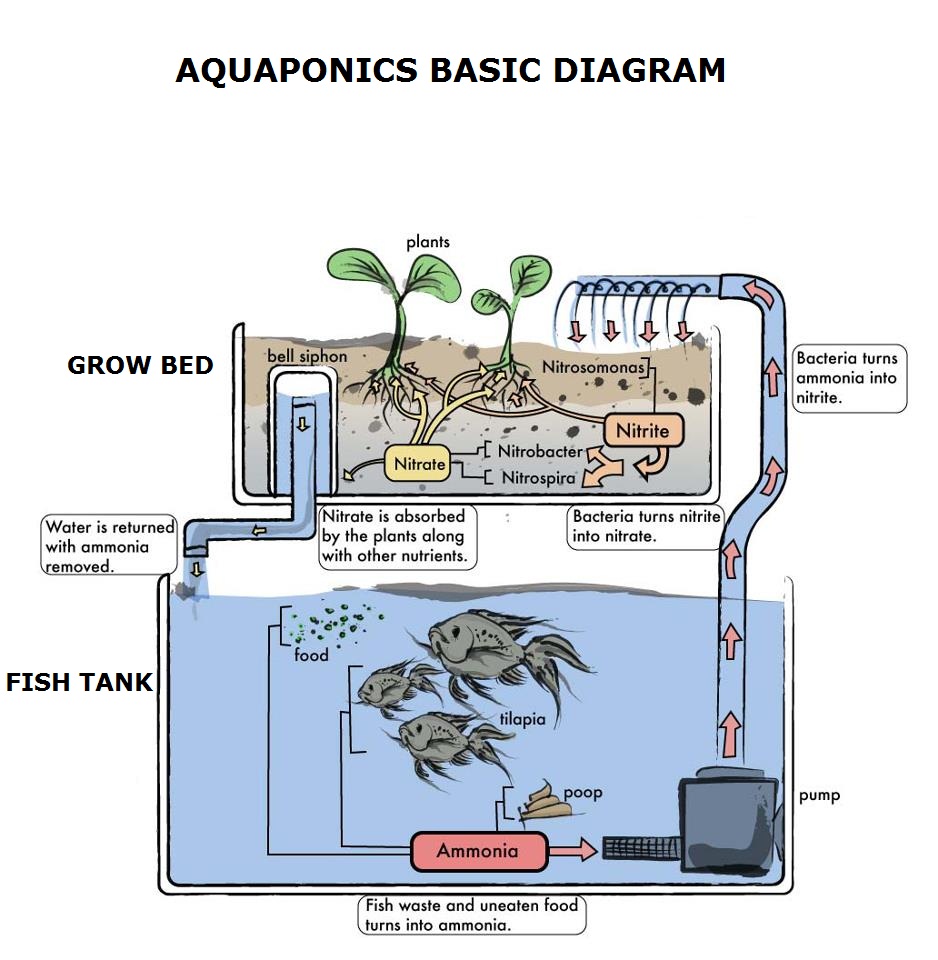
          The basic idea behind aquaponics is as simple as it is brilliant, the plants and fish grow together in a symbiotic relationship, just as in nature. The fish create waste in the form of ammonia which bacteria in the water convert into nitrates which then in turn is absorbed by the plants, serving to both fertilize the plants and filter the water for the fish.
Aquaponics illustration
(Accessed from aquaponicsphilippines.com)
 This idea is by no means new, farmers in South-east Asia have grown rice in paddy fields along with fish for centuries, however, the technology is somewhat new, with the first large scale aquaponics operation being started in the mid 1980’s in Germany and still operating today. As a movement, aquaponics is growing quickly with new facilities opening up all over the world, especially in urban areas where farming space is more limited. With any luck, Foodchain is only the first of many large scale aquaponic operations in Kentucky's future.

Foodchain: Lending a Helping Hand


Taken from the Foodchain Facebook Page
            Foodchain wasn’t my first option. It wasn’t even my second or third one. Foodchain came in fourth on my list of preferred places to volunteer. However, after much research through their website and social media pages, the organization seems like it will be extremely enjoyable. Before hearing of Foodchain, I had no clue what aquaponics was; the first time I heard the word I knew it had something to do with water but that was about it. Now, I know it is the process in which vegetable plants are placed over tanks rich with fish life. The plants thrive off of the nutrients created by the waste of the fish and the fish thrive in their tanks as well. One thing I found extremely interested was how Foodchain takes their aquaponics tanks to the next level by introducing smaller versions of their tanks into classrooms of schools all over Fayette County. The vegetables produced from these tanks are incorporated into the school lunches to help reduce food costs.
Taken from Foodchain website: www.foodchainlex.org

            Back inside of their location in Lexington, the vegetables grown are used by the restaurants that share the building with Foodchain. Their website says that “[Foodchain’s] success is dependent upon all of our neighbors, so that we are able to support each other and grow as symbiotically as possible” (Foodchainlex.org). Not only do they share their vegetables with their surrounding neighbors, but they also receive benefits from their neighbors as well. For example, the brewery housed next door gives Foodchain the grains that would normally be thrown away; these grains are used by Foodchain as a major component of their fish food.

            I am incredibly excited now to have some role to play in helping this organization. I recognize that anything helps, whether it is cleaning the fish tanks or leading tours of young students on a field trip. Anything that I do is going to be advantageous to the community and am excited to get the chance to have a part in that.

Initial Post: Reflecting on the Opportunity to Serve

(Accessed from www.foodchainlex.org)

The FoodChain

          When first seeing that I was assigned When first putting the FoodChain down as one of my hopeful options for the service learning in CIS 112, I did not know a whole lot about the organization. The extent from what I knew came directly from the Google document that was provided for all the different organizations and all the different options with the summary of what volunteering would look like for each place. FoodChain drew my eye right off the bat with its initiative and goal to cultivate community within a local area by serving those around them by displaying an efficient, responsible, and eco-friendly way to make food. The concept of simply meeting an immediate, specific need of the people yet still  Being from Lexington, the idea serving those in the inner city and simply meeting the physical, immediate needs of local people while at the same time inspiring and enabling through education on these great food systems was something that made me want to get involved an help in whatever way I could. To me, its the whole concept of give a man a fish you feed him for the day, but teach him how to fish and he no longer has to go hungry if he chooses. Although it is a simplified example, I feel like FoodChain is accomplishing both by meeting initial physical needs with food, but also providing the opportunity for people to learn what it looks like to possibly provide food for themselves if they have the desire too. This is why for me, although technically this "service-learning" is required through CIS 112, I do not view it as a task I "have" to go do, but rather something I want to go be apart of. And honestly, I count it a privilege of working with such a great organization with such applaudable goals. So I am excited to get started and learn to say the least! But enough about me, lets focus on this amazing organization and what they offer.  FoodChain states their purpose simply, yet beautifully, “Our farm demonstrates the most cutting edge, resource conserving techniques in agriculture to inner city residents, inspiring them to reconsider ways in which they can be involved in the cultivation of fresh food. We give people many ways to access and contribute to a healthy, local, and economically diverse food system, whether it be production through farming, gathering of imperfect produce, food processing, marketing, or education. Altogether, we demonstrate community empowerment through shared food, striving towards a more resilient local economy.” After doing more research, I am completely behind this organization and love what they stand for. I am very excited to get started and get involved.  

                                                                                 (Accessed from www.foodchainlex.org)

           
           So now the question moving forward in volunteering and serving is what can I learn from FoodChain. On doing more in depth research on things past their general purpose, I took a look at what volunteering might look like and the details of the FoodChain’s daily procedures. When looking at this, I learned a lot of knew things that I did not know about what their work looks like everyday. Something extremely interesting that I learned is how their food systems actually work. FoodChain uses an indoor aquaponics farm to utilize an efficient way to produce food. Aquaponics essentially stems from two industries, hydroponics which is growing plants without soil, and aquaculture, which is farming fish. FoodChain’s goal is to combine these two to create sustainable agriculture to produce food for the community. The actual process that takes place to do this I found very fascinating. Essentially and in a simplified version they have many fish tanks and thousands of plants. They take the waste from the tilapia in the fish tank to then in turn put on the plants for a natural fertilizer to then create fresh water for the fish and sustainable fertilizer for the plants to produce the healthy food. I honestly think this is awesome! That is just one thing that I have learned from my research, but I plan to learn much more by going and actually being apart of the process and volunteering. One thing I hope to learn from volunteering is what it looks like to connect these local people with sustainable food sources while also learning how to educate them on this issue. With the presented opportunity to get involved with such a good cause and serve people while learning through the process is exactly why the FoodChain was one of my top choices.