Foodchain

Foodchain
(picture from Foodchain website)

Friday, February 26, 2016

The Lexington Rainforest

My first real visit to Foodchain was a surprisingly cool experience. While it was a slight challenge just finding the entrance due to its location on the side of the West Sixth Brewing Company's building, with every guest having to walk directly through the seafood restaurant that shares the same walls with Foodchain, walking through the main door was like entering a totally different world. Right as I passed the threshold my glasses steamed up and sweat started beading up under my now unbearably hot sweatshirt, it was like I had walked into a tropical rain forest in the heart of central Kentucky. However, I was soon adjusted to the unseasonable heat and humidity and was able to start taking in the sights around me. Directly past the front door was a small 10 gallon fish tank with a few small fish swimming around in it which had a serious of hoses traveling from the tank to a small tray with several plants in it, a small, working model of the much larger set up we were about to be acquainted with. After all the new volunteers showed up, Anne, our volunteer organizer and guide, began showing us all around the main room and explaining how aquaponics worked as well as telling us the finer details of Foodchain's set up. Foodchain raises exclusively Tilapia in six large tanks of about 250 gallons a piece, holding 80 fish per tank.
The entire system including the tanks where the plants are kept in water holds around 7000 gallons of water, all constantly being circulated between the fish tanks, the holding tanks, and the plant tanks where many different kinds of leafy, green vegetables are grown. 
To me, one of the more interesting aspects of Foodchain's planting area was how they had solved an issue with lighting. When they first began, the plants grew lopsided or just sideways, growing towards the lights above them. To solve this, the entire lighting system was attached to a garage door opener that slowly and constantly moved the grow lights back and forth over the tops of every plant, ensuring they grew evenly and got comparable amounts of light to each other. All in all, getting to finally tour Foodchain was an incredibly interesting experience and I am now  even more excited to begin the actual volunteer work very soon of harvesting the grown plants and giving tours around the facility on Saturdays.

My first visit to FoodChain

The FoodChain is located in downtown Lexington right off West Sixth Street next to Jefferson Street. Living in Lexington my whole life, one would think that I would have been to this part of town before, but sadly I have not. It was a very interesting area as the community right down the road from FoodChain consists of a Section 8 housing on one side of the street and large, "old money" homes on the other side, quite a unique sight and contrast. It was Thursday, February 18, that I was able to go and visit for the first time for the Volunteer Orientation 101. The group consisted of two other students from my CIS class, an employee from the University of Kentucky, another woman who just wanted to get involved, and Anne our wonderful guide. I did not start out on the best foot as I got lost trying to find the actual location and held up the group for just a few minutes, but once someone pointed me in the right direction the guide was smooth sailing from there. Our guide Anne, was a very welcoming and informative guide. You could tell how much Anne cared about the place and believed in its mission as a whole just from listening to the way she talked. She made me want to get involved just from her willing heart of being willing to serve and her passion. On staff, at the FoodChain there are only four people including Anne so they are undoubtedly committed to the cause. Here are the lovely ladies that run such a great organization and keep the place running efficiently and productively:

retrieved from http://www.foodchainlex.org


Now let's move on to the tour itself. I will be honest, I had low expectations going in. I expected it to be about an hour long process where we would be sitting and being talked at where I learned very little. This is NOT at all what the group experienced. The tour or "Volunteer Orientation 101" went great. It was extremely interactive and beneficial. Anne walked us around the building and showed us all the different facets of what made the FoodChain run. She gave us a run down on the whole process of how aquaponics actually work. This was very helpful for me as I had already read on their website what aquaponics was, but Anne explained it in a way that made sense to me and I understood. Essentially they have six huge tanks of about 7,000 gallons of water total with large tuna fish inside each tank. They take the waste from the fish to fertilize the plants, but they do not take the exact waste from the fish because this would actually be toxic to the plants and kill them, but rather they have a system that filters this waste and turns it into something that is beneficial for the plants and helps them grow. The plants then in turn filter out the water that is then transported back into the tanks for fresh water for the tilapia. Actually hearing this system explained and then being able to witness how it truly worked was astonishing to me. I loved it! We then continued to walk around the different parts of the building and saw how everything else worked. We all then sat down with Anne and she spoke to us about opportunities to serve. A lot of the times she has for regular volunteer options did not work with any of our schedules as students so she was very flexible and willing to work around our schedules to allow us to serve. I am going to begin to serve in giving tours of the facility on saturdays and help harvest things in the aquaponics farm on Thursdays. Overall it was a great experience and I cannot wait to get back and begin volunteering and serving at such a unique and beneficial organization. 


Fish Tanks with Tilapia
retrieved from http://www.foodchainlex.org


Wednesday, February 10, 2016

First Link of the Chain

          I have been called a great deal of things in my lifetime, but neither "agricultural" nor "agrarian" have ever been among them. Despite being raised mostly in a rural environment, I have never liked farming and I do not enjoy raising livestock. However, when I read about Foodchain and its operation I was hooked on the idea of aquaponics immediately. It was almost unbelievable to me that by combining fish farming and hydroponic agriculture not only would it lesson the environmental impact of each but increase the yields of both, all in an entirely organic way. I was even more excited to learn about Foodchain's mission, as not only do they wish to provide access of fresh, locally grown produce to the community, they want to help inspire and teach others in the community how they can grow their own fresh produce, even in an urban environment. In fact, they are currently fundraising to open up a Teaching and Processing kitchen that will host "after school cooking classes for youth, knife skills training, nutrition education, and family meal preparation workshops for low income families and individuals." Simply due to the nature of their operation, Foodchain is one of the most proactive organizations currently attempting to strengthen the local economy and increase quality of life for its Lexington's urban population.
9382650861_ab19ae239f_o
(Accessed from www.foodchainlex.org)
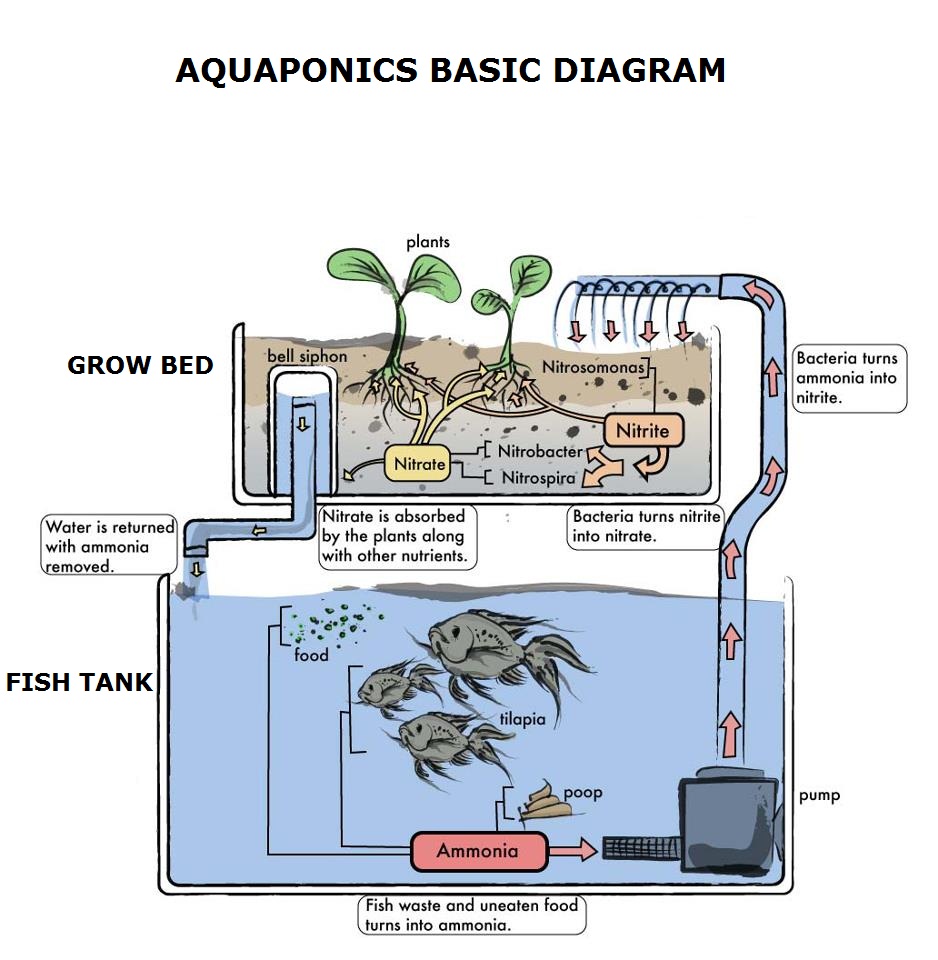
          The basic idea behind aquaponics is as simple as it is brilliant, the plants and fish grow together in a symbiotic relationship, just as in nature. The fish create waste in the form of ammonia which bacteria in the water convert into nitrates which then in turn is absorbed by the plants, serving to both fertilize the plants and filter the water for the fish.
Aquaponics illustration
(Accessed from aquaponicsphilippines.com)
 This idea is by no means new, farmers in South-east Asia have grown rice in paddy fields along with fish for centuries, however, the technology is somewhat new, with the first large scale aquaponics operation being started in the mid 1980’s in Germany and still operating today. As a movement, aquaponics is growing quickly with new facilities opening up all over the world, especially in urban areas where farming space is more limited. With any luck, Foodchain is only the first of many large scale aquaponic operations in Kentucky's future.

Foodchain: Lending a Helping Hand


Taken from the Foodchain Facebook Page
            Foodchain wasn’t my first option. It wasn’t even my second or third one. Foodchain came in fourth on my list of preferred places to volunteer. However, after much research through their website and social media pages, the organization seems like it will be extremely enjoyable. Before hearing of Foodchain, I had no clue what aquaponics was; the first time I heard the word I knew it had something to do with water but that was about it. Now, I know it is the process in which vegetable plants are placed over tanks rich with fish life. The plants thrive off of the nutrients created by the waste of the fish and the fish thrive in their tanks as well. One thing I found extremely interested was how Foodchain takes their aquaponics tanks to the next level by introducing smaller versions of their tanks into classrooms of schools all over Fayette County. The vegetables produced from these tanks are incorporated into the school lunches to help reduce food costs.
Taken from Foodchain website: www.foodchainlex.org

            Back inside of their location in Lexington, the vegetables grown are used by the restaurants that share the building with Foodchain. Their website says that “[Foodchain’s] success is dependent upon all of our neighbors, so that we are able to support each other and grow as symbiotically as possible” (Foodchainlex.org). Not only do they share their vegetables with their surrounding neighbors, but they also receive benefits from their neighbors as well. For example, the brewery housed next door gives Foodchain the grains that would normally be thrown away; these grains are used by Foodchain as a major component of their fish food.

            I am incredibly excited now to have some role to play in helping this organization. I recognize that anything helps, whether it is cleaning the fish tanks or leading tours of young students on a field trip. Anything that I do is going to be advantageous to the community and am excited to get the chance to have a part in that.

Initial Post: Reflecting on the Opportunity to Serve

(Accessed from www.foodchainlex.org)

The FoodChain

          When first seeing that I was assigned When first putting the FoodChain down as one of my hopeful options for the service learning in CIS 112, I did not know a whole lot about the organization. The extent from what I knew came directly from the Google document that was provided for all the different organizations and all the different options with the summary of what volunteering would look like for each place. FoodChain drew my eye right off the bat with its initiative and goal to cultivate community within a local area by serving those around them by displaying an efficient, responsible, and eco-friendly way to make food. The concept of simply meeting an immediate, specific need of the people yet still  Being from Lexington, the idea serving those in the inner city and simply meeting the physical, immediate needs of local people while at the same time inspiring and enabling through education on these great food systems was something that made me want to get involved an help in whatever way I could. To me, its the whole concept of give a man a fish you feed him for the day, but teach him how to fish and he no longer has to go hungry if he chooses. Although it is a simplified example, I feel like FoodChain is accomplishing both by meeting initial physical needs with food, but also providing the opportunity for people to learn what it looks like to possibly provide food for themselves if they have the desire too. This is why for me, although technically this "service-learning" is required through CIS 112, I do not view it as a task I "have" to go do, but rather something I want to go be apart of. And honestly, I count it a privilege of working with such a great organization with such applaudable goals. So I am excited to get started and learn to say the least! But enough about me, lets focus on this amazing organization and what they offer.  FoodChain states their purpose simply, yet beautifully, “Our farm demonstrates the most cutting edge, resource conserving techniques in agriculture to inner city residents, inspiring them to reconsider ways in which they can be involved in the cultivation of fresh food. We give people many ways to access and contribute to a healthy, local, and economically diverse food system, whether it be production through farming, gathering of imperfect produce, food processing, marketing, or education. Altogether, we demonstrate community empowerment through shared food, striving towards a more resilient local economy.” After doing more research, I am completely behind this organization and love what they stand for. I am very excited to get started and get involved.  

                                                                                 (Accessed from www.foodchainlex.org)

           
           So now the question moving forward in volunteering and serving is what can I learn from FoodChain. On doing more in depth research on things past their general purpose, I took a look at what volunteering might look like and the details of the FoodChain’s daily procedures. When looking at this, I learned a lot of knew things that I did not know about what their work looks like everyday. Something extremely interesting that I learned is how their food systems actually work. FoodChain uses an indoor aquaponics farm to utilize an efficient way to produce food. Aquaponics essentially stems from two industries, hydroponics which is growing plants without soil, and aquaculture, which is farming fish. FoodChain’s goal is to combine these two to create sustainable agriculture to produce food for the community. The actual process that takes place to do this I found very fascinating. Essentially and in a simplified version they have many fish tanks and thousands of plants. They take the waste from the tilapia in the fish tank to then in turn put on the plants for a natural fertilizer to then create fresh water for the fish and sustainable fertilizer for the plants to produce the healthy food. I honestly think this is awesome! That is just one thing that I have learned from my research, but I plan to learn much more by going and actually being apart of the process and volunteering. One thing I hope to learn from volunteering is what it looks like to connect these local people with sustainable food sources while also learning how to educate them on this issue. With the presented opportunity to get involved with such a good cause and serve people while learning through the process is exactly why the FoodChain was one of my top choices.